Tag: automotive ac

How to spot counterfeit R134a cylinders UAE

How to Spot Counterfeit Refrigerant Cylinders in the UAE (R134a)

Counterfeit refrigerant risks safety, equipment damage, and customer trust. This guide lists practical checks to identify fake or tampered R134a cylinders and how to protect your workshop or fleet in the UAE.

Why counterfeits are a problem

Fake cylinders may contain off-spec gas or blends that harm compressors, contaminate equipment, and lead to rework. A single bad cylinder can cause multiple returns and costly downtime.

Visual checks (box & cylinder)

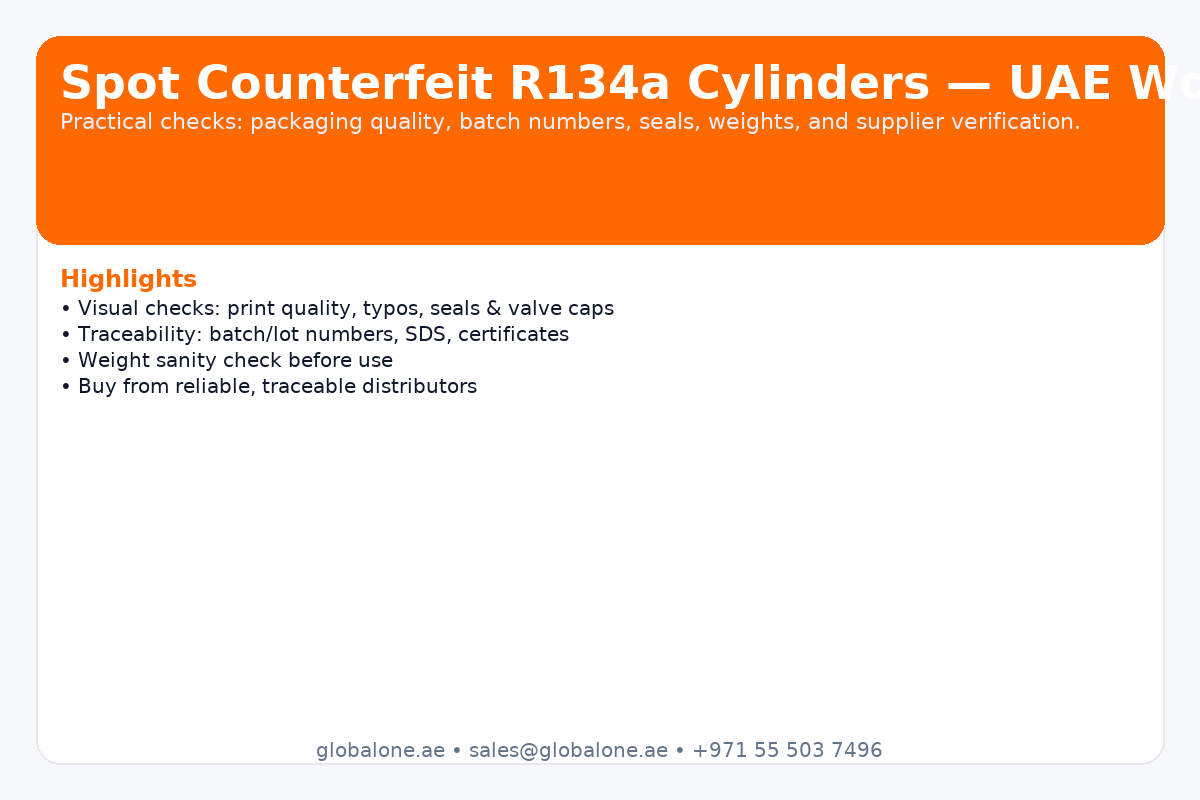
  • Printing quality: Look for crisp fonts, correct logo usage, and clean color blocks. Blurry or misaligned printing is a red flag.
  • Spelling & layout: Typos, inconsistent language, or incorrect label formats often indicate non-genuine packaging.
  • Seals & valve caps: Ensure the cap and threads are clean and intact. Tampered or mismatched parts suggest re-filling or resealing.
  • Cylinder condition: Dents, rust, or re-painted areas can imply reuse or tampering.

Data & traceability

  • Batch/lot numbers: Should be present and legible. Beware of over-stickers hiding original codes.
  • Consistent paperwork: SDS and (where applicable) Certificates (CoO/Conformity). A reliable supplier should share them when requested.
  • Weight sanity check: Weigh unopened cylinders; large deviations from expected net content are suspicious.

Common myths

  • “Cylinder color proves it’s genuine.” Not reliable. Rely on labels, codes, and supplier traceability instead.
  • “It’s fine if it cools.” Off-spec blends may cool initially but damage components and contaminate your machine.

Supplier verification

  • Buy from known distributors with traceable stock.
  • Request documentation (SDS/CoO) where relevant.
  • Be cautious of “too good to be true” pricing. Unrealistic discounts often accompany counterfeit products.

If you suspect counterfeit

  1. Quarantine the stock—don’t connect it to recovery/charging machines.
  2. Record details—photos of labels, batch codes, and supplier info.
  3. Contact your supplier for verification or return procedure.
  4. Service equipment check—if already used, consider filter/drier changes and machine maintenance.

Safer alternatives: genuine supply

FAQs

What’s the fastest authenticity check?

Verify the supplier first. Then check batch/lot numbers and packaging quality. Ask for SDS and relevant certificates.

Is price a red flag?

Unusually low prices can indicate re-filled or counterfeit stock. Always request traceability.

What if a cylinder has different language labels?

Global labeling can vary, but text quality, codes, and consistency should still be professional and verifiable.


R141b flush UAE step-by-step guide

How to Flush an A/C System with R141b in the UAE (Step-by-Step)

How to Flush an A/C System with R141b in the UAE (Step-by-Step)

Flushing an automotive A/C system removes debris, degraded oil, and contaminants—crucial after compressor failure or major component replacement. This guide explains when to flush, how to do it correctly with R141b solvent, and the best practices UAE workshops follow to protect performance and reliability.

Need bulk supply? Order R141b solvent in the UAE or talk to our team via the contact page.

When Should You Flush?

  • Compressor failure (metallic debris or “black death”).
  • System contamination (moisture, sludge, unknown oil).
  • Major component replacements (condenser, lines, expansion device).
  • After improper service/mixing to restore baseline cleanliness.

Tools & Materials

  • R141b flushing solvent (order here).
  • Approved flush gun or machine, inline filter.
  • Recovery unit and manifold set (for the specified refrigerant).
  • Nitrogen or dry air for purging (if required by your procedure).
  • Vacuum pump (deep vacuum capability).
  • New receiver-drier/accumulator and orifice tube/expansion valve as needed.
  • Correct compressor oil per OEM spec.
  • PPE: gloves, eyewear, ventilation as appropriate.

Step-by-Step Flush Procedure

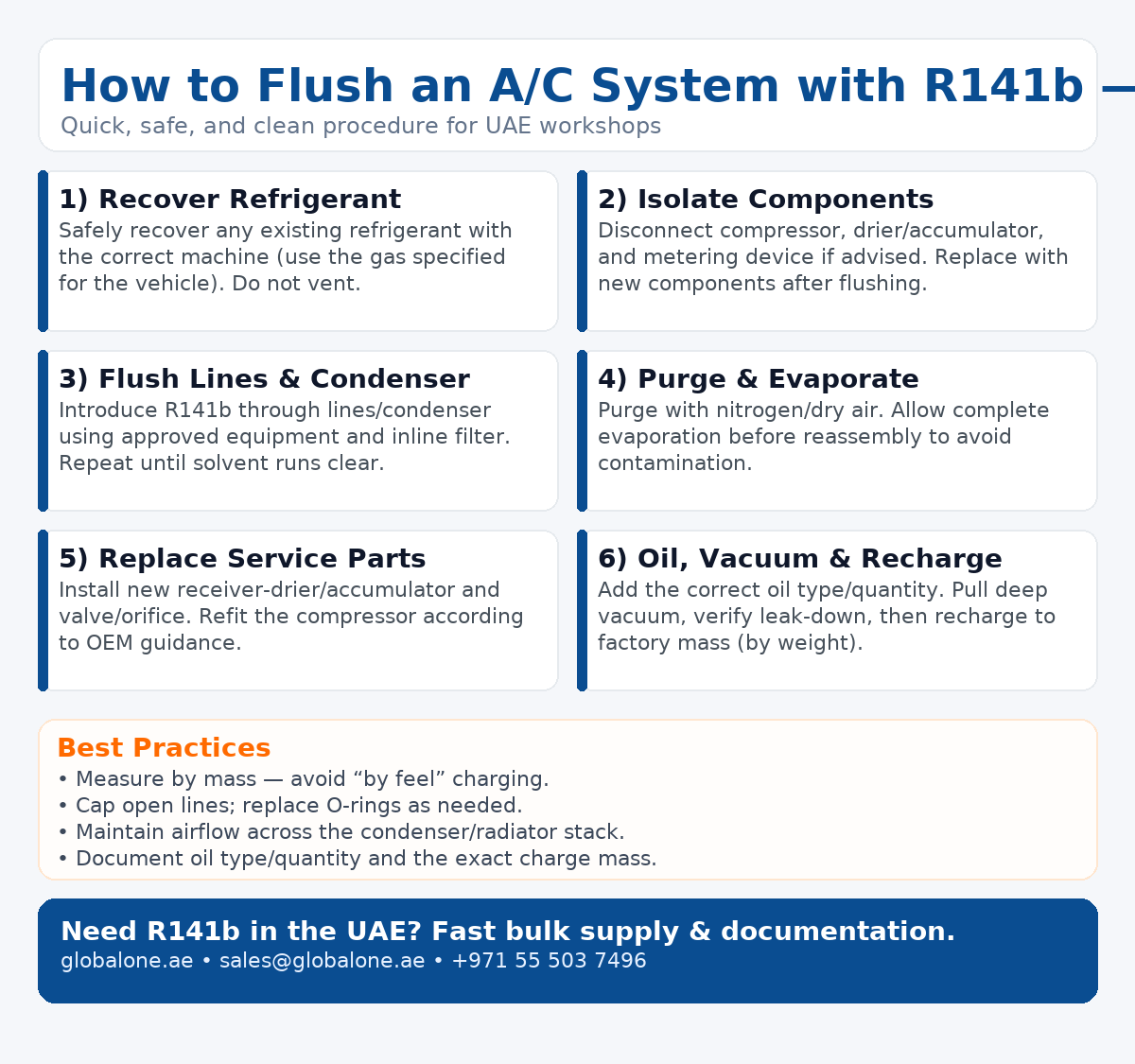
1) Recover Refrigerant

Safely recover any existing refrigerant using the correct machine for the vehicle’s specified gas (R134a or applicable type). Do not vent.

2) Isolate Components

Disconnect components that should not be flushed (e.g., compressor, receiver-drier/accumulator, thermal expansion valve/orifice if advised). Replace these parts with new ones after the flush.

3) Flush Lines & Condenser with R141b

Introduce R141b through the lines and condenser following your equipment’s instructions. Use an inline filter to trap debris. Repeat until the solvent exiting the system runs clear.

4) Purge & Evaporate Solvent

Use nitrogen or dry air to purge. Allow sufficient time for evaporation per product guidance. Ensure no liquid solvent remains before reassembly.

5) Replace Service Parts

Install new receiver-drier/accumulator and metering device (orifice/valve) if required. Refit the compressor (new or remanufactured) per OEM instructions.

6) Oil, Vacuum, and Recharge

Add the correct oil type and quantity. Pull a deep vacuum to remove moisture and confirm tightness (leak-down test). Recharge with the specified refrigerant to the factory fill mass—see Honeywell R134a or Freon R134a (Chemours) for genuine supply.

Best Practices (UAE Workshops)

  • Measure, don’t guess: Charge by mass, not just pressure.
  • Keep it clean: Cap open lines. Replace O-rings as needed.
  • Airflow matters: Ensure condenser/radiator stack is unobstructed.
  • Document: Record oil type/quantity, refrigerant mass, and parts replaced.

Common Mistakes to Avoid

  • Flushing through the compressor (generally not recommended).
  • Re-using a contaminated drier/accumulator.
  • Incomplete solvent evaporation before reassembly.
  • Charging by “feel” instead of factory specifications.

Ordering R141b in the UAE

Global One supplies R141b solvent and refrigerant gases with fast UAE delivery and documentation support.

FAQs

Can I flush the compressor with R141b?

Generally no—follow manufacturer guidance. Flush lines and condenser; replace or service the compressor separately.

How much R141b solvent do I need?

It depends on system size and contamination. Start with a moderate quantity and flush until the exiting solvent is clean.

How long does drying take?

Allow full evaporation after purging, then pull a deep vacuum. Time varies with ambient conditions and procedure.

Do you provide SDS and documentation?

Yes—on request. See our R141b page or contact us.