Tag: r1234yf

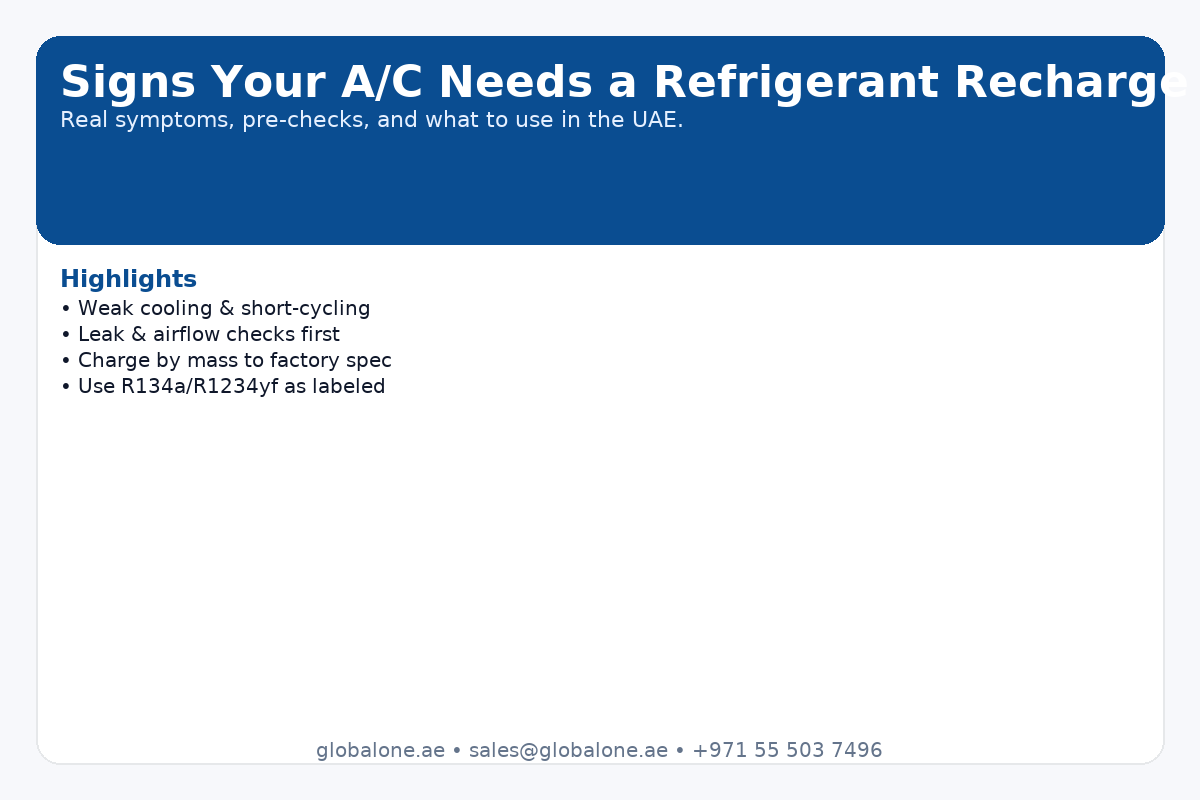
Signs Your A/C Needs a Refrigerant Recharge

Signs Your Car A/C Needs a Refrigerant Recharge (and What to Use in the UAE)

When a car A/C doesn’t cool in UAE heat, the quick assumption is “recharge.” But recharging without diagnosis can waste time and damage components. Here are the reliable signs of low charge, what to check first, and which refrigerant to use.

Real signs of low refrigerant

  • Weak cooling at idle and on the move with fans operating normally.
  • Compressor short-cycling (rapid on/off) due to low suction pressure.
  • Visible bubbles in a sight glass (if fitted) or partial frosting on the evaporator inlet.
  • Static pressures below expected ambient after proper stabilization.

What to check before recharging

  • Airflow: condenser/radiator stack cleanliness; fans engaging; cabin filter not clogged.
  • Leaks: oil traces or dye around hoses, joints, service ports, condenser.
  • Previous service: wrong oil, mixed gases, or contaminated machine can mimic “low charge.”

Use the refrigerant your car was designed for

Follow the under-hood label or service manual. Most vehicles in the UAE are designed for R134a; newer models may use R1234yf. Do not substitute or mix gases. For genuine R134a supply, see Honeywell R134a and Freon™ R134a (Chemours). For contamination cleanup, workshops often use R141b solvent.

Correct recharge procedure (workshop basics)

  1. Recover and measure existing refrigerant mass (don’t vent).
  2. Leak test and repair as needed.
  3. Replace drier/accumulator if system was open or contaminated.
  4. Pull a deep vacuum; verify stability.
  5. Charge by mass to factory spec (label value), not by “feel.”

When a recharge won’t fix it

Restricted expansion valves/orifices, weak compressors, failing condenser fans, or airflow blockages can all cause poor cooling even with a correct charge. Diagnose before topping up.

Order genuine refrigerants in the UAE

FAQs

How often should an A/C be recharged?

There’s no fixed interval—A/C systems are sealed. If you need frequent recharges, you likely have a leak or another fault.

Can I mix different brands of R134a?

Yes in stock management, but inside a vehicle use one refrigerant type only (R134a for R134a systems). Never mix R134a with R1234yf.


R134a vs R1234yf in the UAE Compatibility

R134a vs R1234yf in the UAE: Compatibility, Performance & Service

R134a vs R1234yf in the UAE: Compatibility, Performance & Service

Choosing the right refrigerant matters. Whether you maintain a fleet, run a workshop, or simply want reliable cooling in UAE heat, understanding the difference between R134a and R1234yf helps you avoid costly mistakes. This guide explains compatibility, service requirements, performance considerations, and where to buy genuine refrigerants in the UAE.

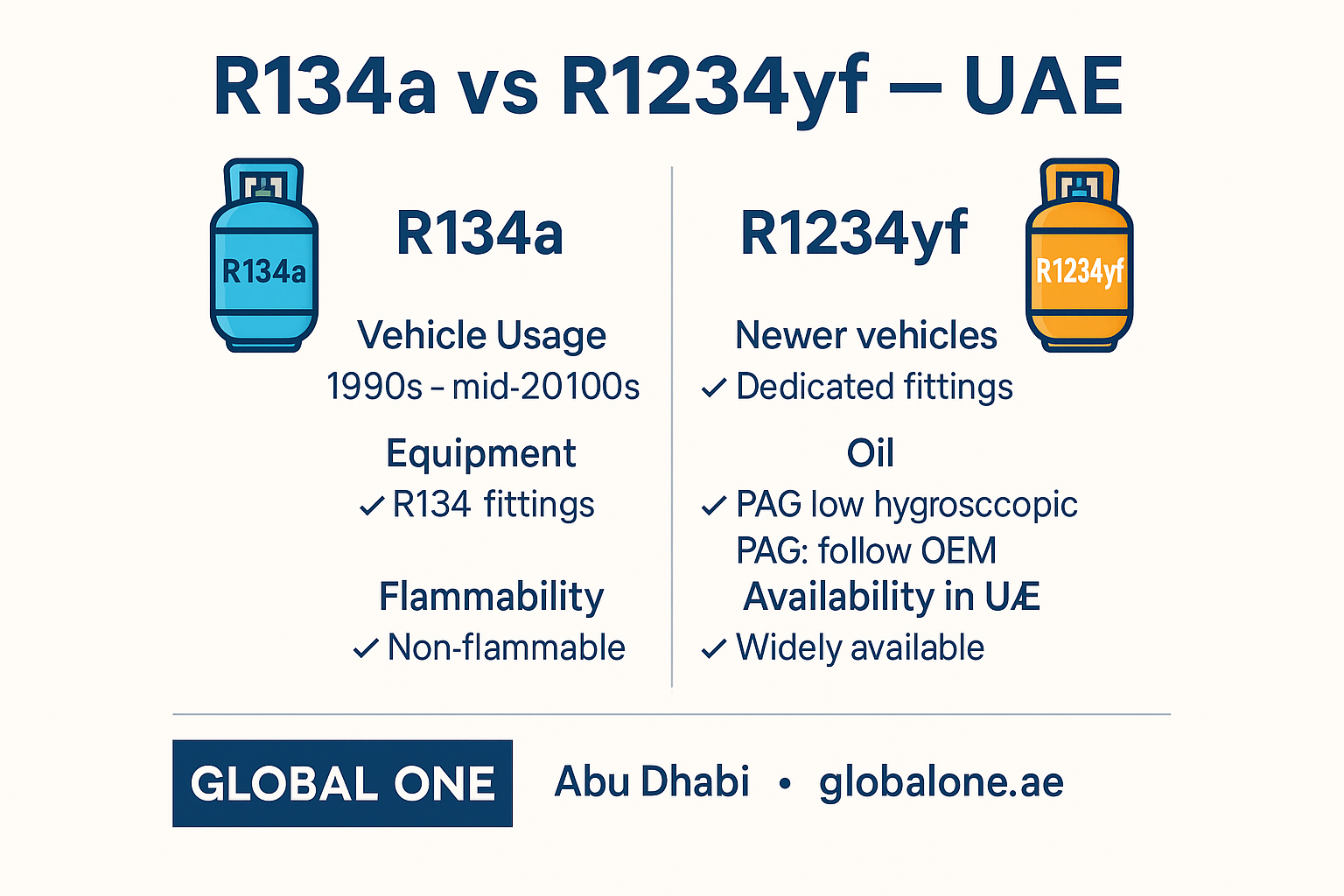
Quick Comparison

Aspect R134a R1234yf
Vehicle usage Common on vehicles from ~1990s to mid-2010s Standard on many newer vehicles
Service fittings & equipment R134a-specific couplers & recovery machines Different fittings; dedicated R1234yf equipment
Oil compatibility PAG (per vehicle spec) Low-hygroscopic PAG; follow OEM spec
Flammability class Non-flammable (per conventional classifications) Mildly flammable (A2L); follow handling guidance
Availability in UAE Wide (workshops & fleets) Increasing, focused on newer models

Which Refrigerant Does Your Car Use?

Check the under-hood A/C label or owner’s manual. Vehicles are designed for a specific refrigerant; mixing or substituting is not permitted. If your label specifies R134a, use R134a only. If it specifies R1234yf, use R1234yf only.

Need help sourcing the right product? See Honeywell R134a UAE or Freon R134a (Chemours) UAE, or explore our Refrigerant Gases service.

Performance in UAE Heat

Both refrigerants can deliver strong cooling when the system is designed for them and serviced properly. For UAE conditions, the biggest performance wins come from accurate charging, clean system internals, correct compressor oil, and unobstructed airflow—regardless of gas type.

Service Differences You Must Know

Fittings & Machines

R1234yf uses different service fittings and requires dedicated recovery/charging machines. Do not try to adapt R134a equipment to R1234yf systems.

Oils & Components

Use the oil type and quantity specified by the vehicle manufacturer. Even within “PAG,” viscosity and additives differ.

Flushing & Cleanliness

If the system suffered compressor failure or contamination, flushing is essential. Workshops often use R141b solvent to clean lines and condensers before recharging.

Cost & Availability in the UAE

R134a is widely available and cost-effective for vehicles designed for it. R1234yf supply is growing across the UAE as more late-model cars arrive. When purchasing, insist on genuine, traceable cylinders from a trusted supplier.

Can I Convert Between R134a and R1234yf?

Converting a vehicle to a different refrigerant is a specialized engineering decision and may not be compliant with manufacturer guidance or local regulations. In practical terms, use the refrigerant the car was designed for.

How to Avoid Counterfeit Cylinders

  • Buy from reputable distributors with traceable stock.
  • Check labels, batch references, and cylinder condition.
  • Be cautious of “too good to be true” deals.

Global One supplies genuine products: Honeywell R134a and Freon R134a (Chemours).

Where to Buy Refrigerants in the UAE

For wholesale supply with documentation support and fast UAE delivery, contact our team:

FAQs

Can I top up an R1234yf car with R134a?

No. Use only the refrigerant specified on the vehicle label.

Can I mix R134a and R1234yf?

No. Mixing refrigerants is unsafe and will compromise performance and serviceability.

How do I know what my car uses?

Check the under-hood A/C label or owner’s manual. Your service advisor can also confirm by VIN.

Do I need to flush the system after compressor failure?

Yes—flushing removes debris and old oil. Many workshops use R141b solvent for this step.